Transactional Alumni Spotlight: Hull Youngblood, JD ´76

As a proud Baylor Lawyer, D. Hull Youngblood, Jr., JD '76, has built his career on the power of showing up, speaking up, and stepping forward. He often reminds students that “there ain’t no money in the harbor,” a colorful way of saying that opportunity only finds those who are willing to leave the dock and chart their own course.
What roles or experiences helped shape who you are and where you are today?
There’s a long story from the show, Deadliest Catch, that I often share. A guy’s boat is in a harbor, with the wind coming from a strange direction. The boat banging against the dock will ruin his vessel. He’s got to get out, go fishing, and make money for his family, but to do that, he has to go through this terrible, narrow strait. It’s five minutes of horrifying, everybody’s-going-to-die kind of stuff. He finally gets out into the open ocean, heads into the wind, and can go fishing. Now he can catch fish, make money for his family, and pay for the boat. He looked at the camera and said, “I had to do that. I know how dangerous it was, but there ain’t no money in the harbor.” Isn’t that a good phrase? You can’t sit in your office and expect to develop a practice. There ain’t no money in the harbor. I tell that story to every new lawyer.
In 1984, I was at a Texas Young Lawyers Association board meeting. Charlie Smith was the president of the bar at the time, and he came to that board meeting to talk about the MCLE Referendum. MCLE requires lawyers to take 15 hours of continuing education each year. The Supreme Court had said, “Here are the rules of the new program, but we’re not going to adopt it. We’re going to submit it to a vote by the lawyers.”
So, Charlie Smith, president of the State Bar, is there to talk about this process of getting education out and informing the lawyers about this referendum to be voted upon, and they’ve found somebody to run this effort statewide. Charlie stands up at the podium, and he says, “…and it’s Hull Youngblood.” He had never said a word to me. He gave that presentation, and said my name, knowing I was in front of 50 of my dearest friends, and they all stood up and applauded. What am I going to do? So I did it. After a huge, long, involved process, we got 67% of the lawyers to vote. The MCLE Referendum passed.
About a year after that, I got a call from Ed Coultas, then the CEO of an Austin-based law firm, and he asked me if I wanted to open the San Antonio office of that law firm. I do it. Twelve years later, Ed is the executive director of Hughes & Luce, a revered firm in Texas with three or four offices across the state. I was currently in a five-lawyer office-sharing arrangement. Ed says, “Hey, how’d you like round two and to join the Austin office of Hughes & Luce?” I did.
What practical experiences, like Practice Court, externships, or student organizations, impacted your readiness to practice law?
Well, obviously, Practice Court! Six weeks into my first job, I was asked to be second chair in a lawsuit. Six weeks. We drive down to George West, Texas, and we try what’s called an FELA case, where a railroad employee is bringing an injury-at-work claim.
Then I remember being called in to work on a company that was going public when I was in my second year. I understood the process. I mean, there was a whole lot I didn’t know—I didn’t know all the details of SEC rules—but I had interned at the SEC office in Fort Worth between quarters.
That internship gave me a lot of hands-on experience with what the SEC does, how they do it, who they go after, and what they’re looking for. It really helped and shaped my ability to handle transactions.
We’ve noticed that you occasionally incorporate some magic during your visits to Baylor Law School. How did that interest in magic begin, and what role does it play in how you connect with others?
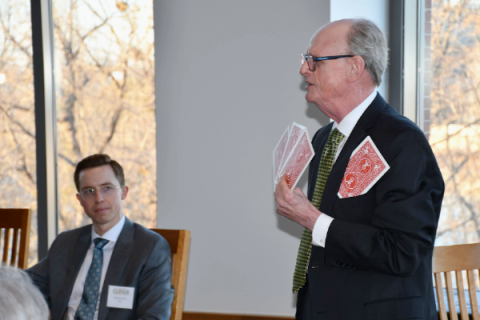
I became interested in magic when I saw a magician at a birthday party when I was nine years old. My mother took me to the library and checked out books on magic. I remember saving up my money and my mother taking me to the magic shop, and I bought my first “real” magic trick for fifty cents. And I started doing magic as a business when I was 15. I could drive back then, and I would do magic at birthday parties and things like that. During undergrad and law school, I made all my spending money doing magic in Waco. Starting at 9 years old, through serving as President of the Texas Association of Magicians, I have had the chance to become friends with some truly remarkable magicians. I have learned a lot from them.
Doing close-up magic, I think, has made me a better transactional lawyer. Close-up magic performed for a few people (as opposed to the big illusions in a theater) requires preparation. Lots of practice to learn the moves. But I learned from my magician friends, and in actual performance, that the biggest secret to successful magic is actually ‘listening” to the audience while you tell a story. You have to watch and listen to your audience. You must learn to react to them, so you can provide the show that they expect. There is a lot of preparation and the art of storytelling and listening in the practice of law. At least there should be.
Every magic trick I do has an opening, a middle, and a conclusion (and sometimes an unexpected twist). Whether it is negotiating a merger, writing a fundraising memorandum, or proposing a project to the local bar association, I always have more success if I plan things as though I am telling a story. Not just all facts.
And of course, be prepared for the inexplicable, like ripping my pants on stage – twice. I will save that story for another time.
If you could give your law school self one piece of advice, what would it be?
When Tom Reavley was a justice of the Texas Supreme Court, he was teaching a class and gave us a brief to read. We had to read the published opinion based on those briefs. He sat down and said, “Okay, what’d you all think of the Supreme Court’s opinion?” I said, Justice Reavley, I think it was the wrong result in the case; a woman lost her case because of a technical procedural point. And I said, I think that was the wrong opinion. I think it was the wrong result. I think she should have won. And here are my reasons why.
Tom Reavley is a big guy with dark features and a shock of dark hair. Dark gray suit, dark tie. To me, he is the embodiment of the judicial system. In a booming voice, he asks, “So that’s how you feel?”
By the way, Justice Reavley wrote that opinion. The room goes deathly quiet, and I know that I’m going to get a D in the class. I looked at him, he looked at me, and said, “I agree with you 100%. That was my first opinion sitting on the Supreme Court, and I just didn’t think my first opinion should have a scathing dissent on what bumble heads the rest of the members of the court were. I just didn’t think that was the appropriate thing to do. So I wrote it the way they wanted it. I agree with you!”
What advice would I give my law school self? I would’ve told myself, “Do more of that and do it sooner.”