Murphey and Skinner Capture Top Honors in Durham, Pittard & Spalding, LLP Fall Moot Court Competition
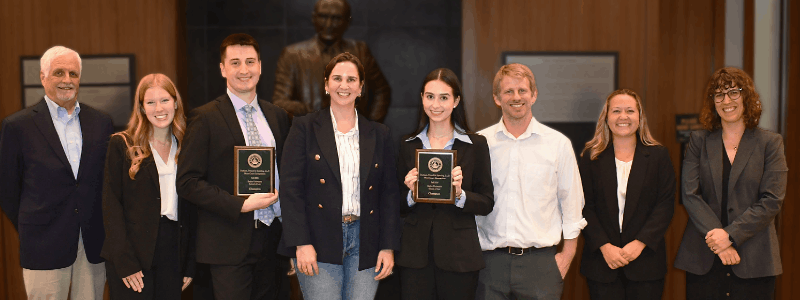
Baylor Law School students Quinn Murphy and Sydney Skinner claimed top honors in the 2026 Durham, Pittard & Spalding, LLP Fall Moot Court Competition, concluding nearly three weeks of competition that challenged students to sharpen their oral advocacy skills while defending their arguments under pressure.
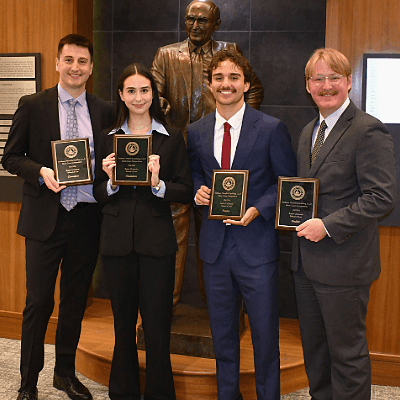
Skinner and Murphy, representing the respondent, prevailed in the final round over finalists Beau Cervantes and Corbitt Armstrong, who represented the petitioner.
The semifinalists were the teams of Joseph Goodale and Abigail Feil, and Annabelle McIntire-Gavlick and Emma McBride.
Individual oral advocacy awards were also presented. Kaleb Bunker was named Best Speaker, Madelyn Kennedy took Second-Best Speaker, and Murphy earned Third-Best Speaker. The remaining Top Ten Speakers, listed alphabetically, were Silas Coggeshall, Abigail Feil, Kara Fields, Joseph Goodale, Ericka McDonald, Annabelle McIntire-Gavlick, and Ashley Schlumpberger.
Learning to Advocate Under Pressure
The competition began on September 11 with 15 teams. Following the preliminary rounds, six teams advanced to the post-break portion of the competition.
For Skinner, this experience enhanced a crucial skill of oral advocacy by fostering the ability to respond thoughtfully when an argument takes an unexpected turn. “Thinking on your feet can be very challenging, especially when the judges are doing anything and everything to throw you off course,” Skinner remarked. “I definitely improved at really thinking about the call of the question and what was being asked, especially compared to our first prelim round.”
Murphy stated that participating in the competition boosted his confidence as an advocate. “One thing I’ve struggled with since starting law school is imposter syndrome. We are surrounded by other students with serious intellectual firepower,” Murphy noted. “But competing in this competition raised my confidence significantly, so that by the final, I had the confidence to walk to the podium and speak without fear of inadequacy.”
A Criminal Procedure Challenge
This year’s competition marked a departure from recent competitions by presenting students with a criminal case rather than a civil dispute.
The fictional case revolved around Mary Clarence, an 88-year-old Catholic nun and peace activist who was convicted of breaking into a federal nuclear facility while protesting against nuclear weapons. Clarence received a six-year prison sentence and was ordered to pay $28,500 in restitution.
The case presented competitors with two questions of criminal procedure. The first asked whether the Sixth Amendment right to a jury trial requires a jury to find the facts underlying a criminal restitution award beyond a reasonable doubt, or if a judge can make those findings based on a preponderance of the evidence. The second asked whether money deposited into a federal inmate’s account by family, friends, and online supporters can be applied toward the inmate’s restitution obligations under the Mandatory Victims Restitution Act.
The problem required students to master complex legal issues and prepare for unexpected questions. Skinner experienced that firsthand during the final round when a judge asked her to compare restitution in criminal law with the concept she had learned in contract law. “That was an unexpected question,” Skinner said. “Connecting two rules of law from completely different contexts certainly poses a challenge. I took a few moments to breathe, collect my thoughts, and rack my brain all the way back to Contracts I with Professor Bates to answer that one effectively.”
Preparation and Confidence
Murphy credited extensive preparation with helping him handle moments when judges’ questions pulled him away from his planned argument. “I remember there were several times where I felt I was being led away from my game plan,” Murphy said. “I was able to overcome that because I prepared for many, many hours. That’s what the Baylor Law brand is all about, after all—preparation.”
The 2026 Durham, Pittard & Spalding, LLP Fall Moot Court Competition involved more than just the student competitors. Clinical Assistant Professor Jessica Kincaid coordinated this year’s competition with the Moot Court Society Board, which is made up of six student officers, overseeing nearly three weeks of rounds involving the 15 teams and volunteer barristers. Her work included developing the competition problem, coordinating the many judges and volunteers needed throughout the preliminary and post-break rounds, and helping guide the competition from its opening practice round through the final. In addition, more than 150 Baylor Law School barristers volunteered throughout the preliminary and post-break rounds, serving as judges, bailiffs, and alternates. Their participation gave competitors repeated opportunities to develop their arguments and to experience the kind of questioning they will encounter in practice.
For Skinner and Murphy, the experience also reinforced where they hope their legal careers will take them. “I was a litigation paralegal before law school. The reason I came to Baylor Law was to become a trial lawyer,” Skinner said. “This competition solidified that for me.”
Murphy reached a similar conclusion. “This competition confirmed something my family and I have known all too well for many years: I love to argue,” Murphy said. “While I enjoy legal writing, nothing compares to getting on your feet and advocating. Whether I advocate on my feet at trial or at the appellate level, one thing is certain—I want to litigate.”
The final round was judged by Chief Justice Shelby White, a Baylor Lawyer and Of Counsel at competition sponsor Durham, Pittard & Spalding, LLP; Baylor Law School Associate Professors Chris Jaeger and Rachel Kincaid; Adjunct Professor Mike Berry; Clinical Assistant Professor Caroline Stewart; and Spring 2026 Moot Court Competition winners Kenzie Gillette and Lilly Hawkins.
Baylor Law School extends its appreciation to the more than 150 barristers who volunteered their time and expertise throughout the competition and to Durham, Pittard & Spalding, LLP for its continued sponsorship and support of Baylor Law School’s advocacy program.